Game plan · built 2026-06-04
Turning Memsist into a real business.
How to market it, promote it, and stand it up — positioning, who buys, where to find them, how to deliver, the numbers, and the first 90 days.
- 1 · The opportunity & your edge
- 2 · The offer (and the moat)
- 3 · Who actually buys
- 4 · Where to find them
- 5 · Marketing, in phases
- 6 · How you deliver it
- 7 · The economics
- 8 · Risks & guardrails
- 9 · First 30 / 60 / 90 days
- 10 · The pilot
01
The opportunity & your edge
Millions of people live with memory impairment — traumatic brain injury, stroke, early dementia, normal aging — and the consumer "AI memory" gadgets that could help are sold as self-serve cloud products the very people who need them can't set up or trust. That's the gap.
Your edge is threefold and hard to copy: (1) you live the problem (you run your own lifelog for your own memory), (2) you have the sysadmin skill to host it privately, and (3) you sell local-first privacy — the data never leaves the home — which the cloud players structurally can't match. The product is free/open; the business is the service and the trust.
02
The offer — and the moat
A productized, done-for-you service: the Keeper (a wearable) plus in-home setup, training, and ongoing managed support. Pricing as published: Home Setup from $299 one-time, Peace of Mind from $49/mo. The monthly is the prize — recurring revenue and a real relationship.
The moat isn't the tech (anyone can download it). It's: white-glove setup for people who can't DIY, a local-privacy promise competitors can't make, a trusted local face, and a caregiver relationship. Lean on all four.
03
Who actually buys
Split the buyer from the user. The user is the person with memory loss; the buyer/decider is almost always the adult-child caregiver or spouse — often tech-aware, anxious, and willing to pay for peace of mind. Market to the caregiver; design for the user.
- TBI / stroke survivors and their families (often younger, motivated, insurance/settlement funds)
- Early dementia / MCI households wanting to delay a facility
- Aging-in-place seniors and their out-of-town children
- Care managers & therapists who recommend tools to families
04
Where to find them
This is a referral and local-trust business first, online second. Build the network:
- Clinical referrers Neurologists, physiatrists, OT/speech therapists, rehab centers, brain-injury clinics — they advise families daily.
- Support orgs Brain Injury Association of Texas, Alzheimer's Association chapters, stroke support groups, Area Agencies on Aging.
- Care channel Home-health agencies, geriatric care managers, elder-law attorneys — referral-fee partners.
- Local online Google Business Profile + local SEO ("memory aid / dementia help Central Texas"), Nextdoor, targeted Facebook caregiver/TBI/dementia groups.
- Word of mouth Every happy family is 2–3 referrals; ask for them, with consent for a short testimonial.
05
Marketing, in phases
06
How you deliver it
Under the hood: an open-source wearable, OEM-labeled as the Keeper, for in-person capture; optional open-source desktop capture for computer users; self-hosted transcription — all running on a small home mini-PC you provide and own on the client's behalf, with nothing in anyone's cloud. A simple voice "ask" interface is the part you'll polish most; it's the differentiator and the hard part.
Per install: source + OEM the wearable, image a mini-PC with the stack pre-built, do the in-home setup + caregiver training, then manage it remotely (with permission). Standardize this into a repeatable kit so each setup is hours, not days. (Wearable reference below; full software stack + migration notes in the private continuity doc.)
06b · Device reference (private)
The hardware behind the Keeper.
The OEM source is the Omi open-source wearable by Based Hardware (formerly "Friend") — open hardware + firmware, local-first, no mandatory subscription. You'd relabel this as the Keeper. Real photo + specs for reference:
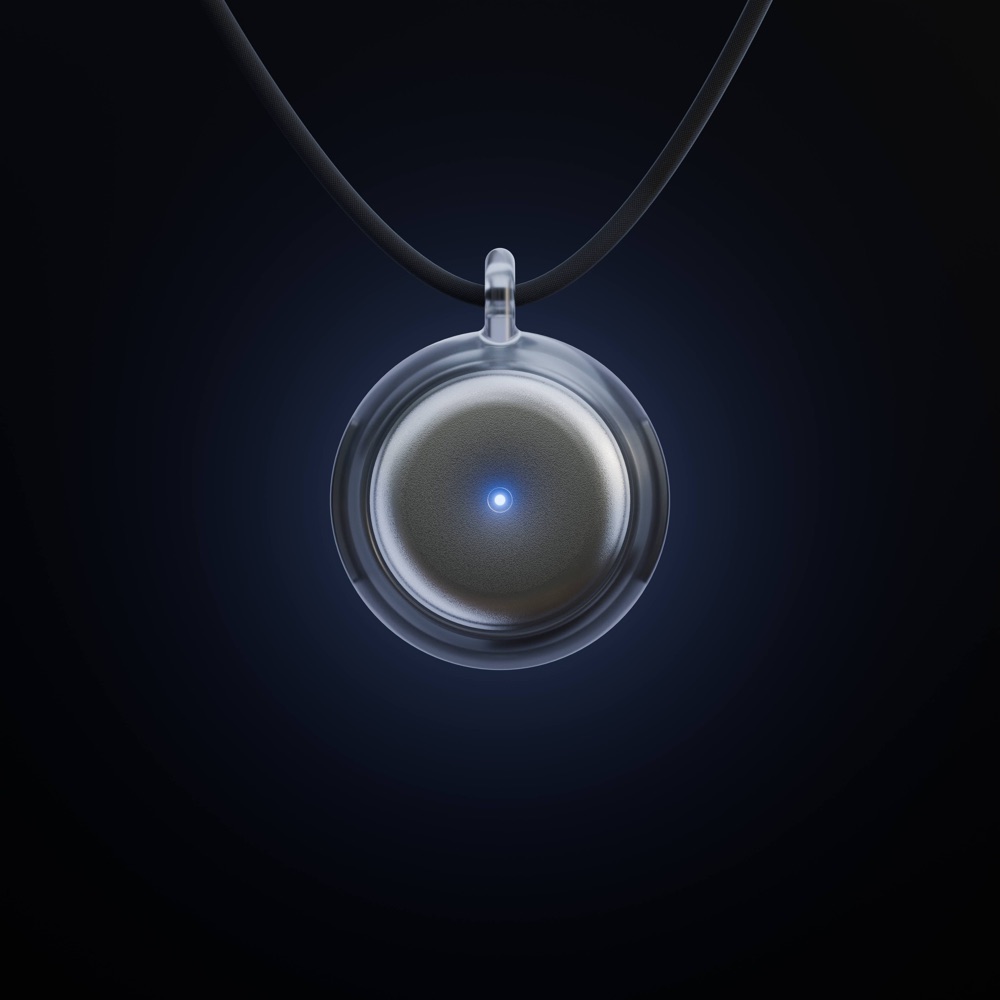
Photo: Based Hardware (reference only) — replace with your own labeled unit before any public use.
- Form Round pendant, ~2.5 cm diameter × 1.5 cm tall — worn on a necklace.
- Battery 150 mAh; ~10–14 hrs continuous listening; USB-C charge.
- Connectivity Bluetooth LE 5.2; Wi-Fi 2.4/5 GHz.
- Microphones 2× high-sensitivity MEMS; noise reduction; speaker recognition.
- Recording Offline-capable; latency ~0.5–2 s live, 10–20 s offline.
- Security TLS in transit, AES-256-GCM at rest (we run it fully on-prem/local).
- Open Open-source hardware + firmware — own the data, runs on your device.
- Cost ~$89/unit at pre-order — your hardware cost before OEM/volume pricing.
07
The economics
- Setup ($299+) Covers the wearable + a mini-PC + your in-home time. Price up where a settlement/insurance or willing family supports it.
- Monthly ($49+) Near-pure margin once running — remote check-ins + upkeep. This is the business. 50 clients × $49 = ~$2,450/mo recurring; 200 = ~$9,800/mo.
- Costs Hardware per client (one-time), your time (front-loaded at setup), minimal hosting (it's their box). No per-seat cloud fees — that's the whole point.
- Goal Get the setup near break-even and live on the recurring base. Protect your time: productize, then delegate setups.
08
Risks & guardrails
- Privacy / consent You're recording vulnerable adults and the people around them. Texas is one-party-consent for audio, but get clear caregiver/family consent, document it, and coach considerate use. This is a care relationship — treat it like one.
- Support burden Clients can't self-fix. Design for low-touch + a caregiver in the loop; remote management; sane defaults; never ship something fragile.
- "It's free, why pay you?" Your answer: setup, privacy, trust, and a real person — none of which is free. Don't compete on software.
- Vendor risk The exact tools will change (you just lived this with a prior vendor). Own the data + pipeline; treat any single tool as swappable.
- Don't overpromise It's a memory aid, not a medical device or a cure. Keep claims honest.
09
First 30 / 60 / 90 days
10
The first pilot
Your first pilot candidate is ideal — real memory impairment, steady income, and already in your orbit. Use him to build the playbook: what setup really takes, what questions he actually asks the device, what the caregiver loop looks like, where it's confusing. In exchange for a discounted/free pilot, ask for an honest testimonial.
Keep the hats separate: he's a prospective tenant first. Offer this as a kindness, never as a condition of the room. And solve his real-world constraint (he doesn't drive) as part of showing the service cares about the whole person.
Next
Prove it once. Then repeat.
The whole plan rests on one genuine success. Get the kit working, help the first client, capture the story — everything else is repetition.